Industrial Hangar Doors: What's Right for Large Operations?
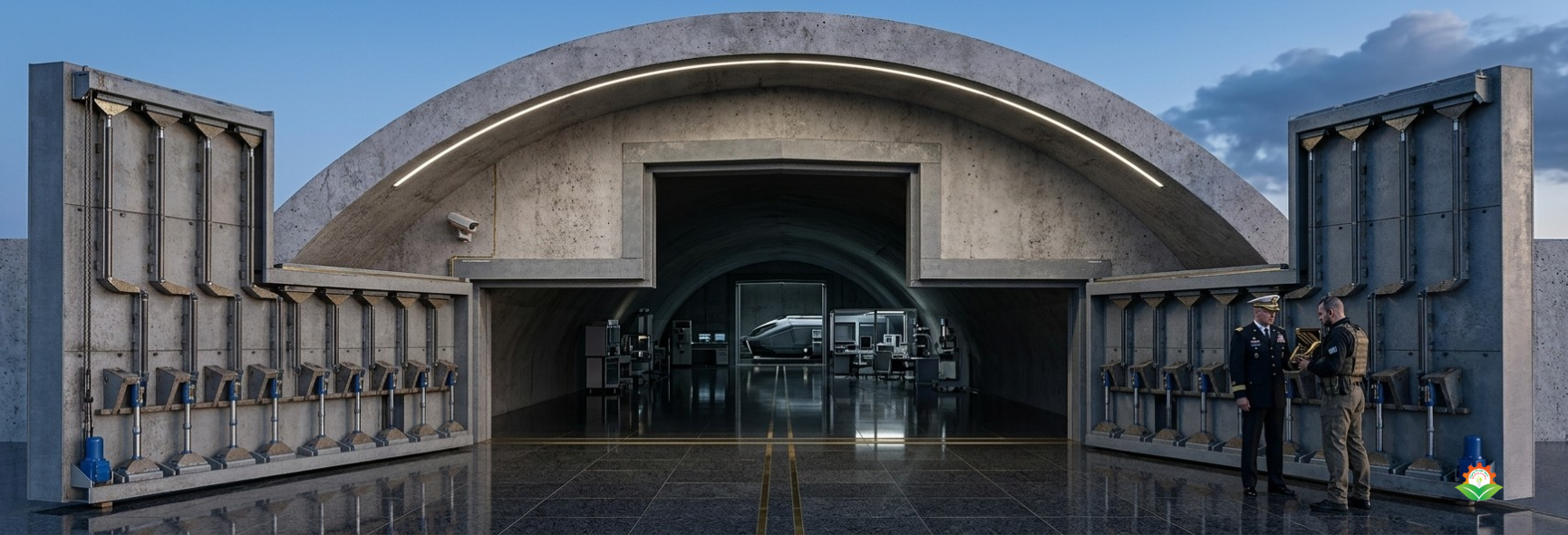
When IndiGo expanded its heavy maintenance capacity at Hyderabad, the facility brief called for hangar bays capable of accommodating two A320-family aircraft simultaneously, with unobstructed internal crane access and a door system that could cycle multiple times per shift without degrading track or automation components. The engineering requirement was not just a large opening — it was a large opening that performs reliably under continuous industrial loading for decades.
That distinction matters. A hangar doors for large operations is not simply a scaled-up version of what works for a general aviation facility. The structural, mechanical, and operational requirements are categorically different, and the engineering approach has to reflect that.
The Scale Problem in Large Hangar Door Engineering
Large aircraft hangars — wide-body MRO facilities, aerospace manufacturing plants, military airbases, and logistics hubs for cargo operators — routinely require clear opening widths of 60 to 120 metres or more, with heights of 15 to 25 metres. At these dimensions, the door system is itself a significant structural element, not an attachment to the building.
The door leaves carry self-weight loads measured in tonnes. Track systems must handle those loads through thousands of operational cycles without progressive wear that degrades alignment. Wind-load forces on a 90-metre door face in an exposed location reach values that require the door structure to be engineered like a bridge span, with deflection limits and connection details appropriate to dynamic loading rather than static conditions.
Standard product ranges stop well short of these requirements. Large operations need engineered solutions, specified and fabricated to project-specific structural data.
Door Configuration Options for Large-Scale Facilities
Matching the System to the Operation
Several door configurations are deployed at scale across large aviation and industrial facilities. Each involves genuine engineering trade-offs.
Bottom-rolling sliding doors are the most commonly specified configuration for wide-body and large transport aircraft hangars. The door leaves run on heavy-duty ground tracks, with upper guides providing lateral restraint. They deliver wide clear openings without the apron clearance penalty of outward-swinging systems, and their structural depth can accommodate the span-to-depth ratios required for rigid performance at large dimensions. The primary maintenance focus is track and wheel assembly condition — contamination management and load distribution across multiple running wheels are critical to achieving design service life.
Bi-fold hydraulic doors offer faster cycle times and are effective where apron depth is constrained. The hydraulic actuation system requires more maintenance attention than electric-drive sliding systems, and the folding geometry creates structural complexity at large dimensions. They are well-suited to military airbases and MRO facilities where rapid access and compact apron footprint are both operational requirements.
Hydraulic vertical lift doors are deployed where the structural arrangement of the facility makes horizontal operation impractical — certain aerospace manufacturing buildings and high-bay facilities where overhead crane systems occupy the wall zone above the opening. Vertical lift systems impose significant structural loads on the building frame and require careful integration with the primary structure from the design stage.
Telescopic sliding doors reduce the wall length required to stack open door leaves, making them valuable where hangar door design is constrained by adjacent structures, taxiways, or facility boundaries. Multi-panel telescopic systems for very wide openings require precise engineering of the interlocking leaf interfaces to maintain weather performance and structural continuity under wind loading.
What Large Operations Actually Need From a Door System
Cycle frequency determines wear rates more directly than raw dimension. A military airbase with high sortie rates cycles its hangar doors far more frequently than a commercial MRO facility on a scheduled maintenance rotation. The automation system, drive components, and track or suspension hardware must be specified for the actual operational tempo, not a conservative average.
Corrosion resistance is non-negotiable for facilities on India's coastline — naval aviation facilities on the western and eastern seaboards, offshore helicopter hangars, and coastal MRO bases face salt-laden air that degrades standard steel surface treatments faster than inland equivalents. Hot-dip galvanising combined with appropriate topcoat systems, or aluminium alloy construction for secondary elements, extends service life considerably under these conditions.
Integration with facility management and airfield operations systems is increasingly a design requirement for large operations. Door control systems need to interface with aircraft movement authorisation protocols, fire suppression system interlocks, and in defence environments, security and access control infrastructure. Suppliers of aircraft hangar door systems who cannot demonstrate this integration capability are not adequately equipped for complex large-operation projects.
For facilities where the operational brief extends to blast protection — including defence airbases and government aerospace installations — the structural performance requirements for the door system extend beyond wind-load and self-weight engineering. Technical resources covering the overlap between large-format door engineering and blast-rated performance are available through Hangar door specifications that address these combined requirements.
Investment Factors at Scale
Large door projects carry procurement values that make thorough supplier evaluation genuinely important. The cost variables that matter most are fabrication quality, drive system reliability, and long-term parts availability — not unit price on a comparison sheet.
A door system that requires track replacement after eight years instead of twenty, or whose automation components are sourced from a discontinued product line, carries a whole-life cost that bears no resemblance to its initial procurement price. Hangar Door Manufactures in India with established large-project delivery records and in-country service capability offer a meaningful advantage over import-dependent alternatives when it comes to long-term operational support.
Common Specification Errors on Large Projects
Undersizing the automation drive for actual operational frequency is one of the most persistent errors in large hangar door procurement. Drive systems specified for rated load at low cycle frequency fail prematurely when facilities operate at higher tempo than the design assumption.
Failing to account for differential settlement in large hangar foundations leads to track alignment problems that develop progressively over the first few years of operation. The door specification and the civil engineering must be coordinated, not developed independently.
Overlooking the maintenance access requirement for track, wheel, and drive components on large sliding systems results in maintenance being deferred because it is operationally inconvenient — accelerating the wear progression the maintenance was intended to control.
Conclusion
Large operations demand door systems engineered to match their actual structural, operational, and environmental conditions — not adapted from smaller-scale products. Configuration, drive system, corrosion protection, automation integration, and long-term service support all require deliberate specification rather than default selection.
The investment in a properly engineered airplane hangar door system at the outset pays consistent operational dividends throughout a facility's working life. Large operations cannot afford access system failures — the aircraft availability and throughput consequences are too significant. Specify to operational reality, engage suppliers with demonstrable large-project capability, and treat the door system as the critical infrastructure it is.
Type a comment
Latest comments
No comments so far. Be the first to comment!
Similar articles